.png)
Nano-electronics Systems & Materials Research Team
(NeoSMaRT)

RESEARCH
Current Areas of Study

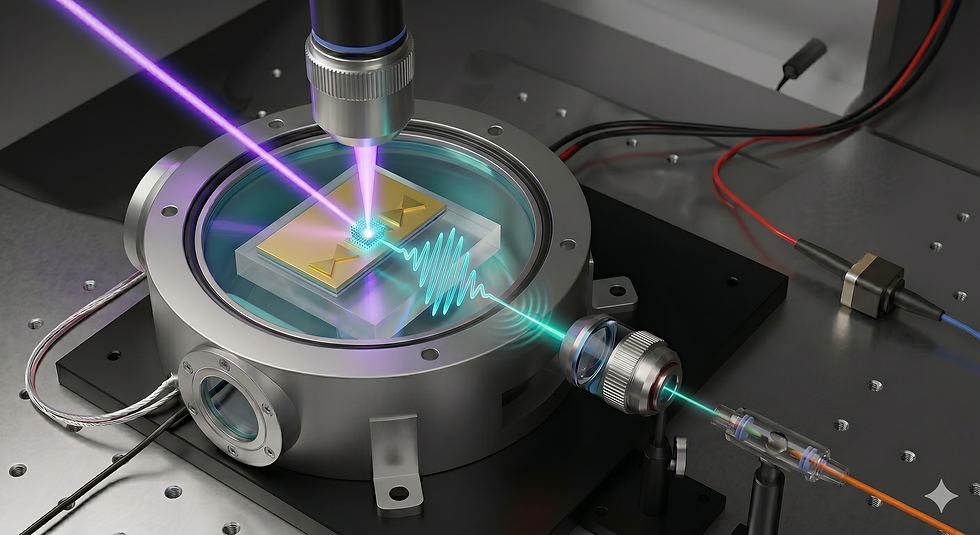
Single Photon Source using Low-Dimensional Materials
We are constantly looking out for new materials for generating a single photon. Our research focuses on the design, deterministic positioning, and integration of reliable Single Photon Sources (SPEs/SPSs). By leveraging the unique quantum confinement of 2D layered materials and localized crystal defects, we aim to generate pure, indistinguishable single photons on demand at room temperature.
Why do we need these single photon sources?
Quantum Computing & Information Processing: Single photons serve as the ideal flying qubits for optical quantum computing.
Next-Generation Data Security: Quantum Key Distribution (QKD) relies on the absolute security guaranteed by the laws of quantum mechanics.
Quantum Random Number Generation (QRNG): True randomness is foundational to modern cybersecurity and complex stochastic simulations.
Quantum Sensing & Metrology: Beyond computing and cryptography, our single photon emitters are designed to act as ultra-sensitive nanoscale probes.
Nanowire-based Resistive Switching Devices
Our group investigates the synthesis, physical mechanisms, and architectural integration of nanowire-based resistive random-access memory (RRAM). Due to their high surface-to-volume ratio, exceptional structural crystallinity, and ultra-small physical footprints, 1D nanowires present an ideal platform for ultra-dense, low-power electronic components.
By precisely engineering the composition, interfaces, and defect chemistry within these nanowire geometries, we develop highly scalable memristive elements optimized for two primary pillars of next-generation hardware:
Non-Volatile Memory (NVM) Architectures: We exploit digital, filamentary resistive switching to engineer high-density RRAM arrays. Our focus centers on achieving high ON/OFF resistance ratios, prolonged data retention, extreme endurance cycles, and immunity to sneak-path currents—positioning these devices as prime candidates for next-generation storage-class memory and embedded systems.
Neuromorphic Computing & Synaptic Plasticity: To emulate the human brain's energy efficiency, we harness the analog, non-filamentary, or controlled multi-filamentary switching behaviours of nanowires.
Hardware-Level Neural Networks: By assembling these nanowire memristors into crossbar configurations, we implement energy-efficient hardware accelerators capable of performing high-throughput, in-memory computing (IMC).

Molecular Materials for Artificial Synapse, Memory and Sensing Applications
Our research explores the vast, tunable landscape of molecular and organic materials to pioneer the next generation of flexible, biocompatible, and ultra-low-power electronic hardware.
Tunable Molecular Synapses: Unlike rigid inorganic crystals, molecular materials allow us to fine-tune electronic and synaptic behavior through precise chemical synthesis and structural modification. We engineer molecular thin films to exhibit highly linear and symmetric Long-Term Potentiation and Depression (LTP/LTD), enabling high-accuracy training in artificial neural networks (ANNs).
Multimodal and Bio-Compatible Neuromorphic Hardware: Molecular systems offer a unique bridge to biological environments due to their mechanical flexibility, soft interfaces, and capacity for mixed ionic-electronic conduction (similar to biological neurons).
Low-Power Multi-Level Memory: By exploiting redox states, molecular isomerism, or electric-field-induced conformational changes, we develop non-volatile molecular memory devices. These systems support multi-bit storage capability per cell, drastically increasing data storage density while operating at a fraction of the energy required by conventional silicon components.

Oxide-Based Thin Film Devices for Switching and Neuromorphic Applications
Our research extensively investigates transition metal oxide (TMO) thin films to develop highly reliable, scalable, and energy-efficient resistive switching hardware. By utilizing advanced thin-film deposition techniques, we precisely engineer oxygen vacancy profiles, defect chemistry, and interfacial properties within oxide layers.
Volatile vs. Non-Volatile Switching Dynamics:We tune the kinetics of oxygen ion/vacancy migration and phase transitions within the oxide matrices to achieve distinct switching behaviours
Hardware Emulation of Biologically Plausible Learning: We exploit the analog conductance modulation of oxide thin films to replicate intrinsic brain functions. Our devices successfully mimic critical synaptic characteristics
Brain-Inspired Energy-Efficient Accelerators:By integrating these oxide thin-film memristors into dense crossbar arrays, we build physical hardware for In-Memory Computing (IMC).

Quantized Conductance and Random Telegraph Noise (RTN) Measurements
To design highly reliable neuromorphic hardware, we look deep into the fundamental electron and ion transport physics at the atomic scale. Our group utilizes precision nano-electrical characterization techniques—specifically focusing on Quantized Conductance and Random Telegraph Noise (RTN) analysis—to investigate the stochastic dynamics of defect movement, atomic rearrangement, and filament formation within 1D nanowire-based systems. These advanced measurement protocols allow us to map out quantum and stochastic phenomena with sub-nanometer resolution:
Quantized Conductance in Atomic Scale Filaments: As a nanowire-based memristor switches, the forming or dissolving conductive filament can shrink to the width of a single atom. We perform high-resolution, room-temperature, and low-temperature electrical testing to observe the quantization of conductance in integer multiples of the quantum unit:
Random Telegraph Noise (RTN) as a Spectroscopic Tool: RTN manifests as discrete, stochastic fluctuations in device current, typically caused by the capture and emission of single electrons by individual trap sites or the hopping of single oxygen ions near a conductive pathway. We leverage RTN analysis as a non-destructive spectroscopic tool to:
Extract critical spatial and energetic parameters of atomic defects (trap depth, relaxation time, and capture/emission cross-sections).
Evaluate the long-term reliability and stability of synaptic weights in neuromorphic hardware.
Harnessing Physics-Based Stochasticity for Security:While RTN and atomic variations are often viewed as noise sources in conventional memory, we strategically harness this intrinsic, physics-based stochasticity. By characterising and controlling these microsecond-scale fluctuations, we develop robust hardware primitives for True Random Number Generators (TRNGs) and Physical Unclonable Functions (PUFs), providing hardware-intrinsic security for the Internet of Things (IoT) and edge computing devices.
